Owly: A Display Font with Built-In Woodland Magic
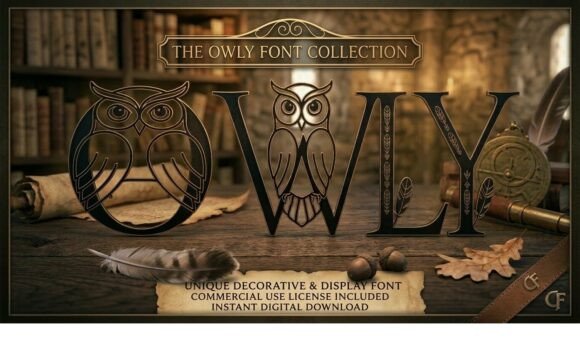
When you're working on a project that demands attention, the typeface you choose carries enormous weight. Most fonts do their job quietly, stepping back to let the message shine. But every so often, you encounter a typeface that refuses to disappear into the background. Owly is exactly that kind of font. It's a decorative display typeface where every letterform doubles as a piece of intricate illustration, featuring clean-line owl drawings woven into bold serif structures. The result is something genuinely distinctive: a font that feels simultaneously classic and enchanting.
What makes Owly stand apart from other decorative fonts is its restraint. Despite the ornamental nature of the design, the linework stays clean and deliberate. There's an Art Deco sensibility running through the geometry, a sense that every curve and angle was considered carefully. The owl illustrations don't overwhelm the letterforms; they complement them. You get the impression of a skilled illustrator who also understands how type needs to function. That balance between artistry and usability is surprisingly rare in display typography.
Where This Font Truly Comes Alive
Let's be honest about something: Owly is not a body text font. You wouldn't set a paragraph of product descriptions with it, and nobody should try. This is a premium font built for specific, high-impact moments. Think of it as the accent wall in a room rather than the paint covering every surface.
Drop caps are where Owly genuinely excels. If you're designing an editorial layout for a magazine, a book chapter opener, or even a blog post that deserves a polished presentation, a single oversized Owly letter anchoring the first paragraph creates an immediate focal point. The owl illustration gives readers something to linger on before they settle into the text. It signals care, creativity, and intentionality without saying a word.
Short, impactful words work beautifully too. A hero headline on a landing page, a single word on a poster, a brand name lockup on packaging design. When you only need a few characters, every letter gets room to breathe, and that's when the detailed owl motifs really register with viewers. I've seen this kind of display font used effectively on book covers in the fantasy and nature genres, on artisan product labels for small-batch goods, and on event invitations where atmosphere matters more than information density.
Brand Identity and Audience Connection
Choosing a typeface for your brand identity is one of those decisions that looks simple from the outside but carries real consequences. The fonts you use shape how people perceive your business before they read a single word. Owly communicates something very specific: creativity, a connection to nature or the outdoors, a sense of whimsy balanced with sophistication. If those qualities align with your brand's personality, this creative font can become a powerful recognition tool.
A small-batch candle company, an independent bookstore, a children's education platform, a nature retreat, or a creative agency with a playful edge could all use Owly strategically. The key is understanding that this font makes a statement. It's not neutral. It carries warmth and character, which means it needs to be paired with the right context. A law firm probably isn't the right fit, but a wildlife conservation nonprofit might find it perfect for campaign materials.
When used consistently across touchpoints like social media graphics, packaging, and web design headers, a distinctive typeface like Owly builds recognition faster than most people expect. Audiences start associating that visual language with your brand. The owls become shorthand for your identity.
Pairing and Practical Considerations
Because Owly is so visually rich, it demands a thoughtful font pairing strategy. You need something clean and understated to handle the heavy lifting of longer text. A simple sans serif font works well for modern, minimal projects. A straightforward serif font can complement it for more traditional or editorial contexts. I'd avoid pairing it with another decorative, script font, or handwritten font unless you're going for deliberate visual chaos, which is a valid choice but a narrow one.
Before committing to Owly for a project, test it at the actual size you'll be using. Display fonts that look stunning at large scales can lose definition when scaled down. Since the owl illustrations are integral to the design, you want to make sure they read clearly. Most professional design assets include multiple styles or weights, so review what's included in the package. Check whether the license covers your intended use, especially if you're working on commercial font applications like client work or products for sale.
Readability is worth a direct conversation here. For the handful of words Owly is designed to handle, legibility shouldn't be an issue. But context matters. A decorative initial letter on a dark background needs enough contrast to register. A headline on a busy photograph might get lost. Always step back and ask whether someone unfamiliar with the font could identify each letter without effort. If the answer is yes, you're in good shape.
Getting the Most from a Distinctive Typeface
The best uses of modern typography happen when designers match the tool to the task rather than forcing a favorite font into every project. Owly rewards selective, intentional use. Set one word in it and let everything else support that choice. Use it for a chapter opener, not an entire book layout. Feature it in your logo design if the brand personality warrants it, but give it a supporting cast of simpler typefaces for everyday communication.
I've found that the most effective creative professionals treat fonts like Owly as specialized instruments. You wouldn't use a fine brush for painting a wall, and you wouldn't use a roller for detail work. This premium font is your fine brush. It handles the moments that need precision, personality, and visual storytelling.
For designers, bloggers, publishers, and small business owners who want their projects to feel considered and distinctive, Owly offers something that generic type libraries simply can't. Each letter is a miniature illustration, a piece of art that carries its own quiet magic. Used thoughtfully, it transforms ordinary text into something people actually remember.